
Type 308 Self-Tapping Insert: One-Shot High-Strength Threade

In automotive, consumer electronics, light-alloy die casting, engineering plastics and many other industries, engineers constantly face the challenge of creating a wear-resistant, reusable high-strength internal thread in a low-strength base material (such as aluminium, magnesium, plastics or cast iron). A directly tapped internal thread is often too weak and prone to stripping. The Type 308 self-tapping insert - a thin-walled bushing with its own external thread and tapping edges - taps its own mating thread as it is driven in, producing a high-strength thread pair in a single operation. This article gives a systematic introduction to the structure, principle, performance, installation and selection of the Type 308 self-tapping insert.
1. What is a Type 308 self-tapping insert?
A Type 308 self-tapping insert (self-tapping thread bushing) is a metal bushing with both internal and external threads. Its external thread is a purpose-designed 'self-tapping' tooth form, and the outer circumference carries a number of cutting bores (tapping edges). When screwed into a pre-drilled pilot hole, the cutting bores cut the mating internal thread into the base material exactly like a tap, locking the insert firmly into the base; the internal standard thread then accepts a conventional screw.
Because it taps as it is driven, the 308 insert is used both for new assemblies and as a quick repair part for damaged threads - the original screw size can be reused afterwards.
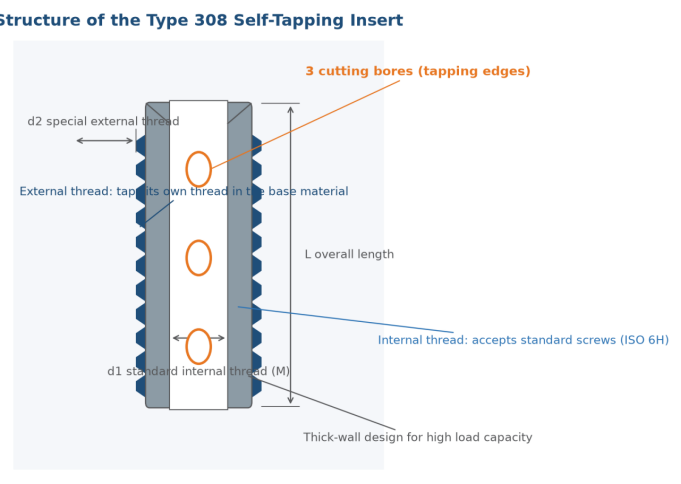
Fig. 1 Structure of the Type 308 insert (d1 internal thread · d2 special external thread · L overall length · 3 cutting bores)
2. Structure and working principle
The 308 belongs to the thick-walled self-tapping inserts with 'cutting bores'. Compared with the slotted 302 series, the three cutting edges of the 308 distribute the cutting force over three edges, making it more suitable for materials with poor cutting properties, while the thick wall gives it a higher load capacity.
During assembly the insert is screwed onto a dedicated driving tool, cutting bores facing down, and driven into the hole. As it turns, the external thread and the cutting bores work together to cut the internal thread in the base, while the chips are evacuated through the cutting bores to prevent blocking. After installation the insert face usually sits about 0.1-0.2 mm below the workpiece surface and can be loaded immediately.
A notable point: the external thread of the 308 distributes the axial load evenly over every individual thread, so even a relatively small-diameter insert can absorb higher axial forces than a connection using a larger-diameter screw.
3. Core performance advantages
On soft substrates such as light alloys, the 308 delivers a very high pull-out strength. Tests show that in EN-AW 5083 and EN-AW 7020 aluminium, the pull-out force of the 308 often exceeds the minimum breaking force of the matching grade 12.9 screw (DIN ISO 898-1), meaning the joint is no longer limited by the strength of the base material.
Because the thread load is spread evenly and the effective shear area is large, designers can often substitute a smaller 308 insert for a larger-diameter, heavier threaded joint, achieving a compact, lightweight design - important for weight-critical applications such as EVs, aerospace and robotics.
4. Installation process
Installing a 308 insert takes four steps: (1) machine the pilot hole - by drilling or directly in the casting, with a 60 degree countersink recommended (N ~ 0.06-0.08 x d2 + d2), which prevents surface build-up, allows deeper driving and improves initial cutting; (2) screw the insert onto the dedicated tool; (3) drive it in so the face is 0.1-0.2 mm below the surface; (4) insert the standard screw to complete the high-strength joint.
The pilot-hole diameter depends on the base material: brittle, tough or hard materials need a larger hole than soft or elastic ones. The insert length is the minimum admissible material thickness, and a blind-hole depth must exceed the insert length. Also ensure a sufficient minimum edge distance (light alloys ~0.2-0.6 x d2, cast iron ~0.3-0.5 x d2).
The table below gives recommended speeds and maximum permitted driving torques by size (reference values; installation trials recommended).
|
Internal thread |
Recommended speed (r/min) |
Internal thread |
Max. permitted torque (N.m) |
|
M 2.5 / M 3 |
600-900 |
M 2.5 |
1.5 |
|
M 4 / M 5 |
400-600 |
M 3 |
2.5 |
|
M 6 / M 8 |
280-400 |
M 4 |
5.5 |
|
M 10 / M 12 |
200-300 |
M 5 |
10 |
|
M 14 / M 16 |
150-200 |
M 8 |
28 |
|
M 18 / M 20 |
120-200 |
M 12 |
60 |
|
M 22 / M 24 |
100-160 |
M 16 |
160 |
|
M 27 / M 30 |
80-140 |
M 30 |
1050 |
5. Product variants and materials
The 308 offers several variants for different conditions: the standard 308 (through-hole, economical and universal), the headed 308 1 (with a flange face for higher bearing area and pull-out force, usable as an electrical contact support or for fastening several parts at once), and the hex-drive 308 2 (hex socket drive, manual or powered, ideal for automated lines).
Common materials include carbon steel (zinc-plated, cost-effective), austenitic stainless steel 1.4305 (corrosion-resistant, for humid or outdoor use) and brass (conductive, wear-resistant, for electrical and precision applications). The internal thread is manufactured to ISO 6H, with general tolerances to ISO 2768-m.
The table lists typical sizes of the 308 2 variant (d1 internal thread, d2 external-thread diameter, P pitch, L overall length, hex across flats, recommended pilot-hole diameter, minimum hole depth; in mm).
|
Size d1 |
d2 |
P |
L |
Hex across flats |
Pilot hole (light alloy) |
Min. hole depth |
|
M 4 |
6.5 |
0.80 |
8 |
3.2 |
6.0-6.1 |
10 |
|
M 5 |
8.0 |
1.00 |
10 |
4.1 |
7.4-7.5 |
13 |
|
M 6 |
10.0 |
1.25 |
12 |
4.9 |
9.3-9.4 |
15 |
|
M 8 |
12.0 |
1.50 |
14 |
6.6 |
11.1-11.2 |
17 |
|
M 10 |
14.0 |
1.50 |
18 |
8.3 |
13.1-13.2 |
22 |
|
M 12 |
16.0 |
1.75 |
22 |
10.1 |
15.0-15.1 |
26 |
6. Typical applications
Thanks to 'one-shot tap, high strength, and repeated assembly', the 308 is widely used across the metal and plastics processing industry: EVs and automotive electronics, consumer electronics / 3C, light-alloy die casting (Al, Mg), engineering plastics and resins, railway equipment, household appliances and medical engineering - especially in weight-sensitive, reliability-critical applications.
It is also an ideal solution for quickly repairing stripped or damaged threads, without changing to a larger size: the original screw size can be reused, saving cost and time.
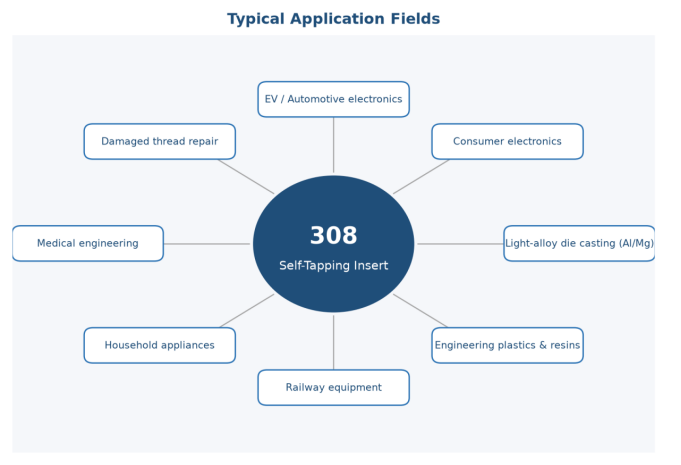
Fig. 2 Typical application fields of the Type 308 insert
7. About Yingfeng Zhichengjia
Yingfeng Zhichengjia Precision Hardware (Shenzhen) Co., Ltd. was founded in 2003 and has more than 20 years of experience in fastener design and manufacturing. It is an innovative company focused on precision fasteners and aluminium-alloy components, with the vision of becoming an innovation leader in precision fasteners and serving global customers with the best total cost and rapid response.
Certified to ISO 9001, IATF 16949, ISO 14001, ISO 45001 and IECQ QC 080000, the company holds 26 valid patents and operates manufacturing bases in Shenzhen, Xiangyang and Indonesia. Its customers include top global smartphone and EV brands, and it supplies material fastening solutions to embodied intelligence, low-altitude economy, AI servers, aerospace, consumer electronics and new-energy vehicles.
If you are interested in the Type 308 self-tapping insert or other material connection solutions, please contact us - we provide full-process support from design selection and prototyping to testing and mass production.
Yingfeng Zhichengjia Precision Hardware (Shenzhen) Co., Ltd. · Web: www.zcjtech.com · HQ: No. 13 Zhongxing Road, Kengzi Street, Pingshan District, Shenzhen · Tel: 13560730094
Note: pull-out strength, speed and torque figures are reference values from test series, not guaranteed values - confirm by actual installation trials. Ensat(R) is a registered trademark of its owner; cited here for technical reference only.
More Blog
- SMT Surface-Mount Technology Small Boards
- Type 308 Self-Tapping Insert: One-Shot Hi
- How Cold Heading Slashed EV Battery Lifti
- ZT68 600MPa Cold-Headed High-Strength Alu
- ZT68 600MPa Cold-Formed High-Strength Alu
- Precision Crafting for a Lightweight Futu
- Yingfeng Zhichengjia Newly Customized Spr
- R&D of ultra-high strength aluminum a